
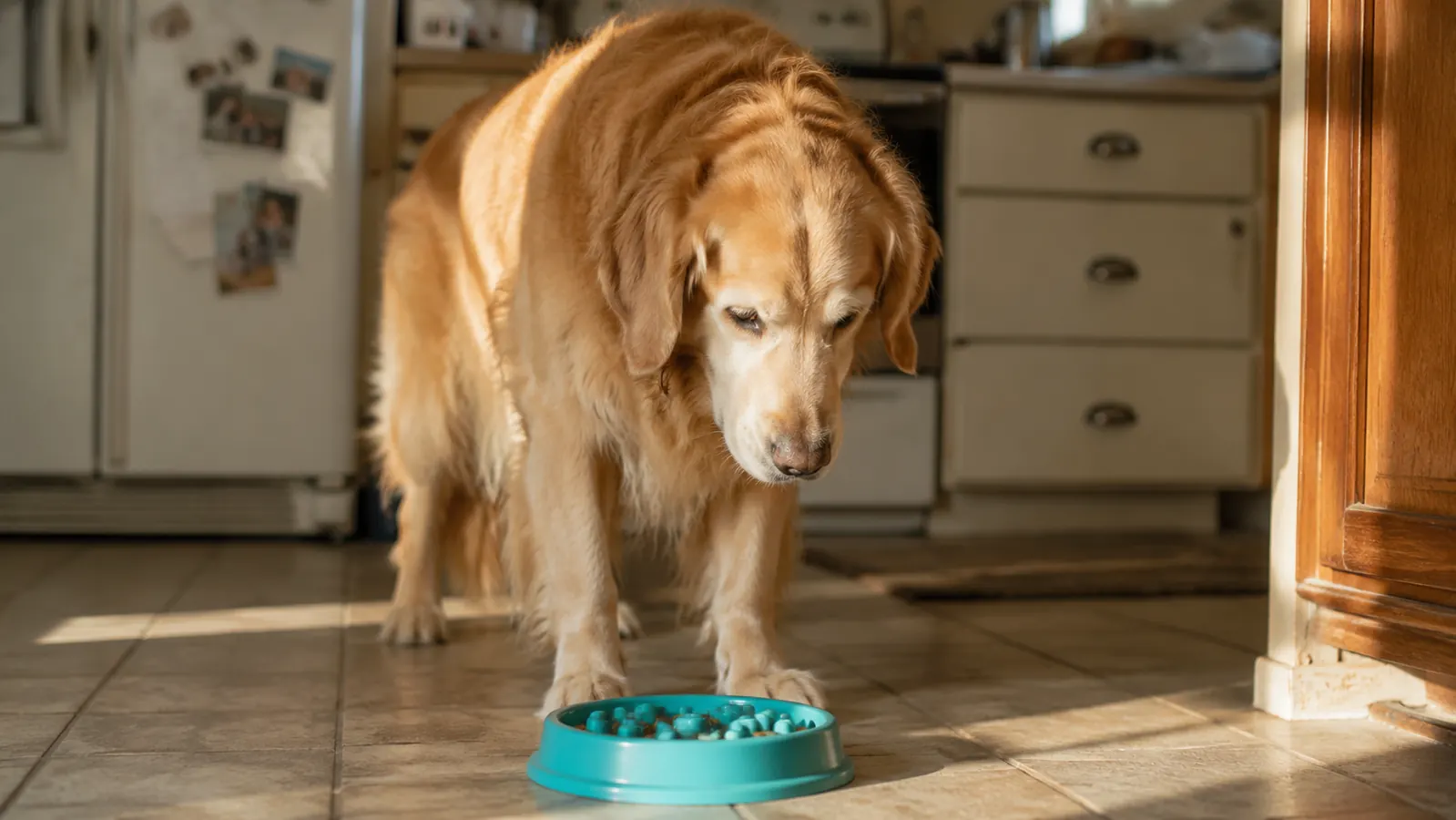
Duke used to finish a full bowl of kibble in well under a minute. I'd set his dish down, turn around to start the coffee, and by the time I turned back he'd be standing there licking the empty bowl across the floor, tags jingling, looking for more. The Outward Hound Fun Feeder Slo Bowl sitting on my kitchen floor now is the only thing that ever changed that. He's a nine-year-old Golden Retriever, seventy-two pounds, and he's eaten like that his whole life, but it got worse after we brought Patches home, our orange tabby, who likes to wander over and sniff his food while he's eating. Duke decided the safest move was to eat faster, and within a couple of years his mealtime had gone from a normal few minutes down to something closer to fifteen or twenty seconds. Twice last year he threw up undigested kibble within ten minutes of eating, and our vet used the word bloat, which for a deep-chested breed like his is not a word I take lightly. That's what sent me looking for it in the first place. It's a turquoise plastic bowl with raised ridges molded into the bottom in a maze pattern, meant to force a dog to eat around and between the bumps instead of just putting his whole face in and inhaling.
I'm not a vet and I'm not a dog trainer. I'm a grandmother who was tired of watching her dog gag and tired of worrying every single mealtime, and this is what actually happened after months of using this bowl every single day, twice a day, rain or shine, grandkids underfoot or not.
The Quick Verdict
A simple, inexpensive bowl that genuinely slowed Duke's eating down and stopped the post-meal vomiting, though the ridges take real scrubbing to keep clean and it won't stop a truly determined fast eater on its own.
Amazon Check Today's Price →Watching Your Dog Gulp Food Like Duke Did?
If mealtime at your house looks like a race, a bowl with the right ridge pattern can slow things down without a single training session. See today's price and current availability before you decide.
Amazon Check Today's Price on Amazon →How I've Used It
I started using the Outward Hound in place of Duke's regular stainless bowl right away, no transition period, because honestly I wanted to see if it would even work before I got attached to the idea. I feed him twice a day, once in the morning around seven and again around five thirty in the afternoon, and I swapped both meals over on day one. The bowl sits on the same spot on the kitchen floor his old bowl always did, a rubber mat underneath so it doesn't slide, though the bowl itself also has a non-slip base molded into it that does a fair amount of that work on its own.
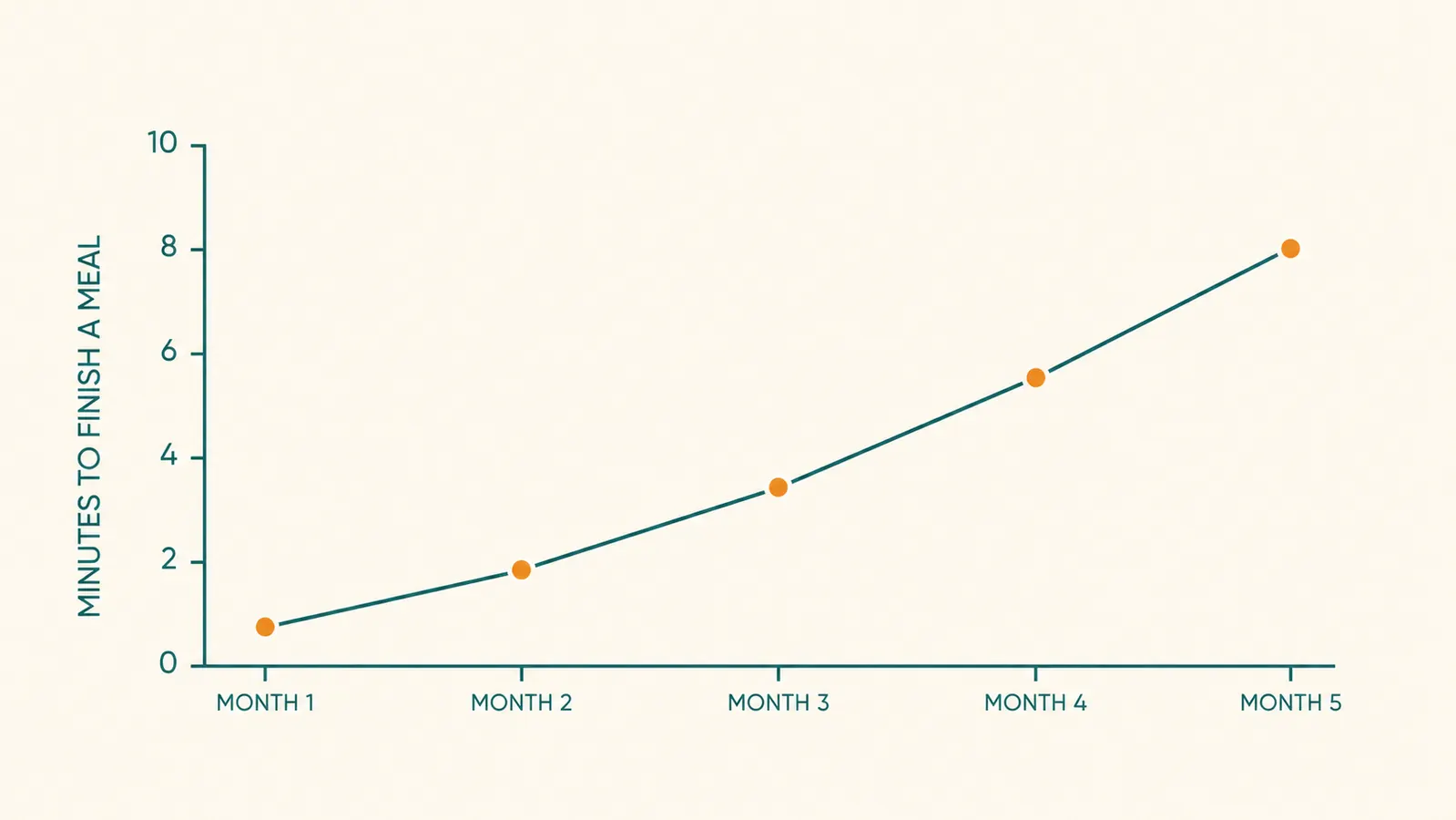
The first meal was almost comical to watch. Duke walked up expecting his usual routine, put his nose down into the bowl the way he always had, and just stopped. He looked up at me like I'd played a trick on him. It took him a good minute of pushing kibble around the ridges before he figured out he needed to work the pieces out from between the raised bumps rather than scoop the whole surface at once. By the third day he had a system, working the outer ring first and then the center, and his overall time went from under a minute to somewhere around four or five minutes right out of the gate.
What surprised me most is that he didn't seem frustrated by it the way I half expected. There was no whining, no pawing at the bowl, none of the anxious behavior I'd braced myself for. He just treats it like a small puzzle now, and if anything he seems more engaged with his food than he used to be, when the whole meal was over before he'd even really tasted it.
How the Ridge Pattern Actually Slows Him Down
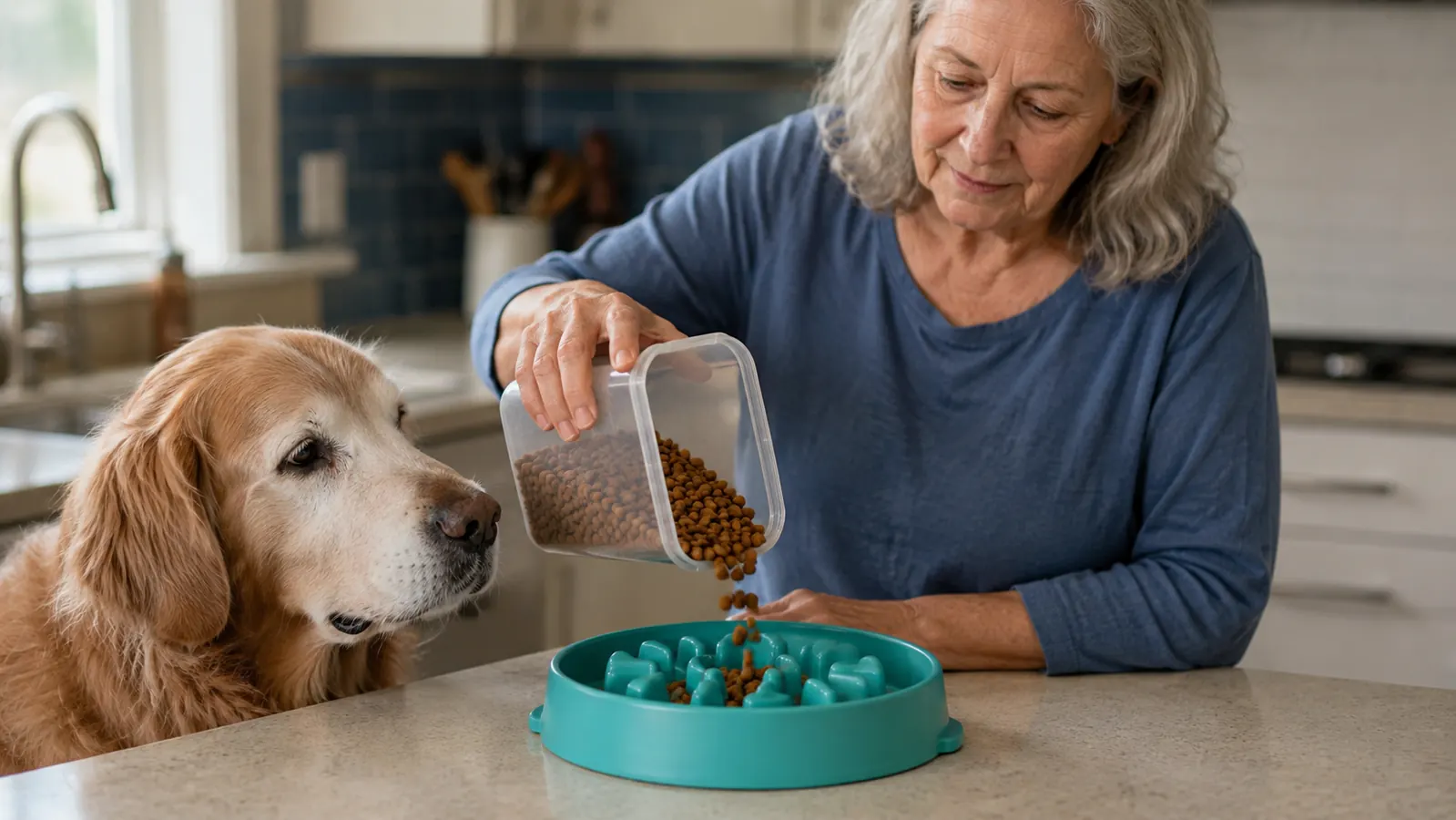
The bowl works by shrinking the amount of open, flat surface a dog can access at once. Instead of a smooth bottom where Duke could just plant his whole muzzle and inhale, the raised drop-pattern ridges break the interior up into narrow channels and small islands of space. He has to work his tongue and nose into the gaps to get the kibble out, one small mouthful at a time instead of one giant gulp, and that mechanical slowdown is really the entire idea behind it. There's no timer, no electronics, nothing that can break, just plastic shaped in a way that makes fast eating physically harder to do.
On Duke specifically, the ridges near the outer rim are what he struggles with most, since his muzzle is wide enough that he has trouble getting good purchase in the tighter outer channels. That actually works in our favor, because it's the outer rim where he used to do the most damage, that first frantic scoop that used to clear half the bowl in one motion. Now that first scoop maybe gets him a fifth of what's there, and the rest takes patience.
I'll say the ridges are more effective on dry kibble than they are on anything wet or mixed with broth, which we do sometimes on cold mornings to get more water into him now that he's older. Add liquid and the kibble floats a bit and slides around the channels more easily, which shortens his eating time somewhat compared to a completely dry meal. It still slows him down versus a flat bowl, just not by quite as much.
Months In: What's Held Up and What Hasn't
The plastic itself has held up well. No cracks, no chips at the ridges despite Duke occasionally pushing the Outward Hound a foot or two across the kitchen floor while he works at it, and the turquoise color hasn't faded or stained even with months of kibble, the occasional splash of broth, and being run through the dishwasher more times than I've bothered to count. For a bowl that didn't cost much, I expected to be replacing it by now, and I'm not.
What has taken more effort than I expected is cleaning between the ridges. Dry kibble dust and the occasional greasy residue from broth mornings settle down into the narrow channels, and a quick rinse under the tap doesn't always get it all out. I run it through the dishwasher most nights, which handles it fine, but on the days I hand wash instead I need an old toothbrush to really get into the grooves, otherwise it starts to look a little grimy after a week or so.
The result that matters most to me is that Duke hasn't vomited after a meal since the second week we started using it. His eating time has settled into a steady seven or eight minutes most days, down from those first frantic under-a-minute meals, and it's stayed there rather than creeping back down as he's gotten more comfortable with the bowl, which was one of my worries going in. I was afraid he'd eventually figure out a workaround and go right back to gulping, but months in, that hasn't happened.
The Easy Cleanup and Arthritis Angle
I have arthritis in both hands, worse some mornings than others, and a bowl I have to scrub hard every single day was a real consideration before I bought this one. The good news is the dishwasher handles ninety percent of the maintenance for me, and the Outward Hound is light enough empty that lifting it in and out of the dishwasher rack doesn't bother my hands or my shoulders the way heavier ceramic bowls do. On the mornings my hands are stiff and I need to hand wash quickly instead, that's when the ridges get the better of me and I end up just doing a fast rinse and running it through the dishwasher again that night to finish the job properly.
The non-slip base has also turned out to matter more than I expected with grandkids around most weekends. Before, Duke's smooth-bottomed bowl would go skidding across the tile if one of the kids brushed past him while he ate, sending kibble everywhere. This bowl mostly stays put even with three grandkids running through the kitchen on a Saturday morning, and that alone has cut down on the amount of stray kibble I sweep up under the table.
What I Compared It To Before Buying
Before landing on this bowl, I looked hard at a couple of the puzzle-style slow feeders, the kind with sliding compartments or removable pieces meant to make a dog work even harder for each bite. I liked the idea, but I was honestly worried about the small parts with grandkids in the house, and I wasn't sure Duke, at nine, needed something that complicated when the goal was simply to slow him down, not turn every meal into a training exercise.
I also thought seriously about just spacing his meals out into smaller, more frequent portions instead of buying a bowl at all, three small meals instead of two normal ones. That helped a little on its own when I tried it for a couple of weeks, but it didn't stop the gulping within each meal, it just meant he gulped smaller amounts more often. Once I added the ridged bowl into that same routine, the combination of smaller portions and a bowl that physically slows him down made the bigger difference than either change did alone.
A Few Small Fixes I've Made Along the Way
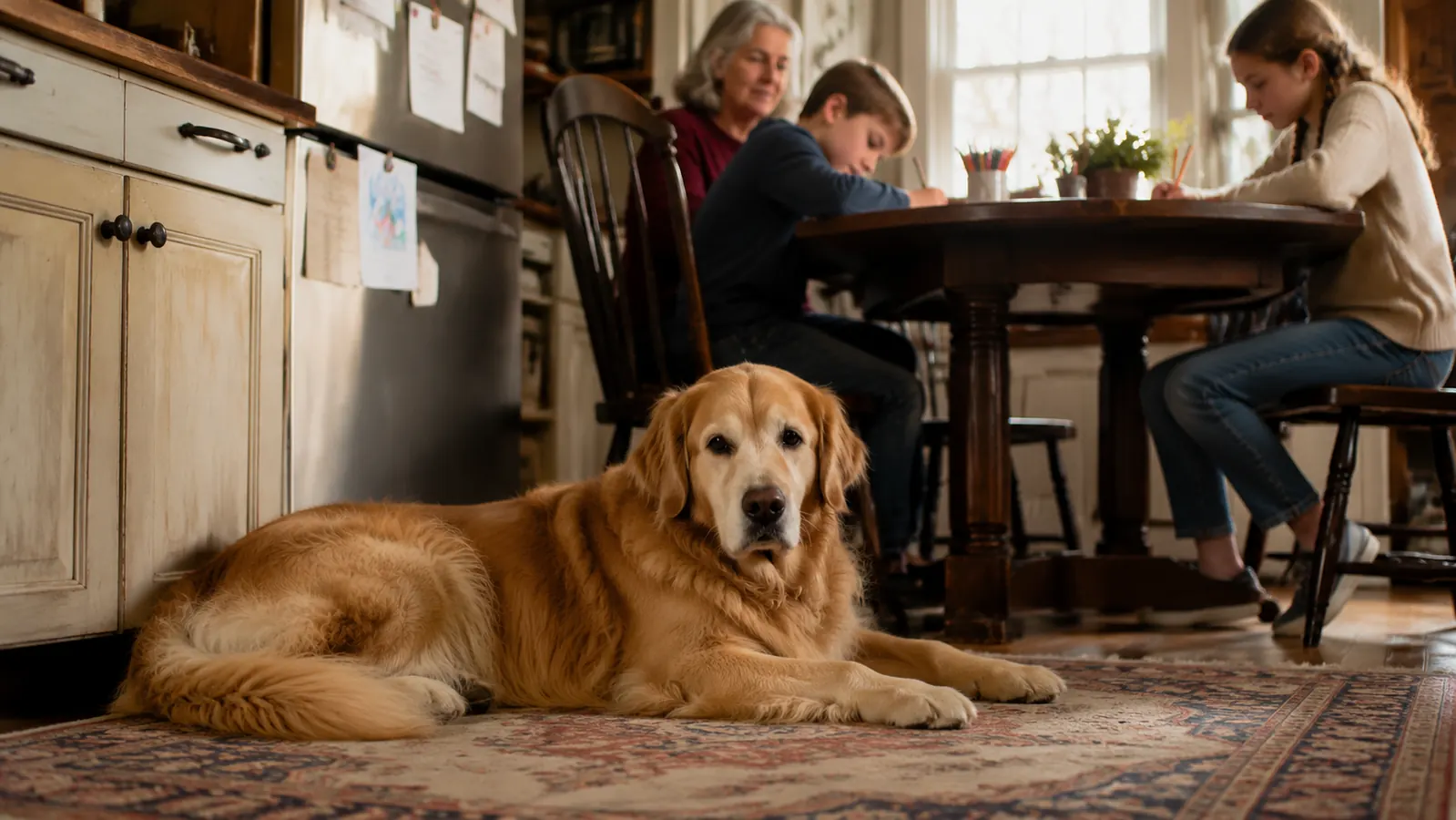
Months of daily use taught me a couple of things no packaging mentions. I learned to place the bowl a few feet from where Patches usually perches at mealtime, since Duke still eats faster when he can see her nearby, ridges or not. Moving his spot slightly out of her sight line calmed that competitive edge down more than I expected it would.
I also started pre-soaking his morning kibble for two or three minutes before pouring it in, which softens it just enough that it doesn't get quite as wedged into the tightest channels, making cleanup a little easier without undoing the slowdown effect. It's a small habit, but it saves me a few minutes with the toothbrush most days.
What I Liked
- Genuinely slowed Duke's eating from under a minute to seven or eight minutes
- No vomiting after meals since the second week of use
- Held up well over months with no cracks or fading
- Non-slip base keeps it in place even with grandkids around
- Dishwasher safe, which matters a lot on my worse arthritis days
Where It Falls Short
- Ridges trap kibble dust and need a toothbrush for a real hand-washed clean
- Less effective once kibble is mixed with broth or water
- A truly determined gulper may still need smaller portions on top of the bowl
- Not ideal if you have very young grandkids who might tug at the raised ridges
The first meal, Duke put his nose down the way he always had and just stopped, looking up at me like I'd played a trick on him.
Who This Is For
If your dog eats the way Duke used to, finishing a full bowl before you've even sat down, or if your vet has mentioned bloat risk for a larger, deep-chested breed, the Outward Hound Fun Feeder is a sensible, low-cost place to start. It's also a good fit for a busy multi-pet household like mine, where competition between animals tends to make fast eaters even faster. For anyone with arthritis or joint pain who still wants something dishwasher safe and light enough to handle without a fight, this checked every box I needed it to.
It's also worth it if you'd rather try a simple bowl before spending more on an interactive puzzle feeder, the way I did. Duke never needed anything more complicated than ridges to eat like a normal dog again, and I suspect a lot of fast eaters don't either.
Who Should Skip It
If your dog is an extreme gulper who barely slows down for anything, ridges alone might not be enough, and you may need to pair a bowl like this with smaller, more frequent meals or talk to your vet about other options. It's also not the right choice if you're feeding a very small or toy breed, since this bowl is sized for medium to large dogs and the channels would likely be too wide to slow down a small mouth. And if easy, quick hand washing without a dishwasher is a must for you, the ridges will be more of a daily chore than you might want to take on.
See Whether a Simple Bowl Change Could Slow Down Your Own Fast Eater
Duke's mealtimes look nothing like they did a year ago, and neither does my worry about him. If your dog eats too fast, check today's price and see if this bowl makes the same difference for yours.
Amazon Check Today's Price on Amazon →