
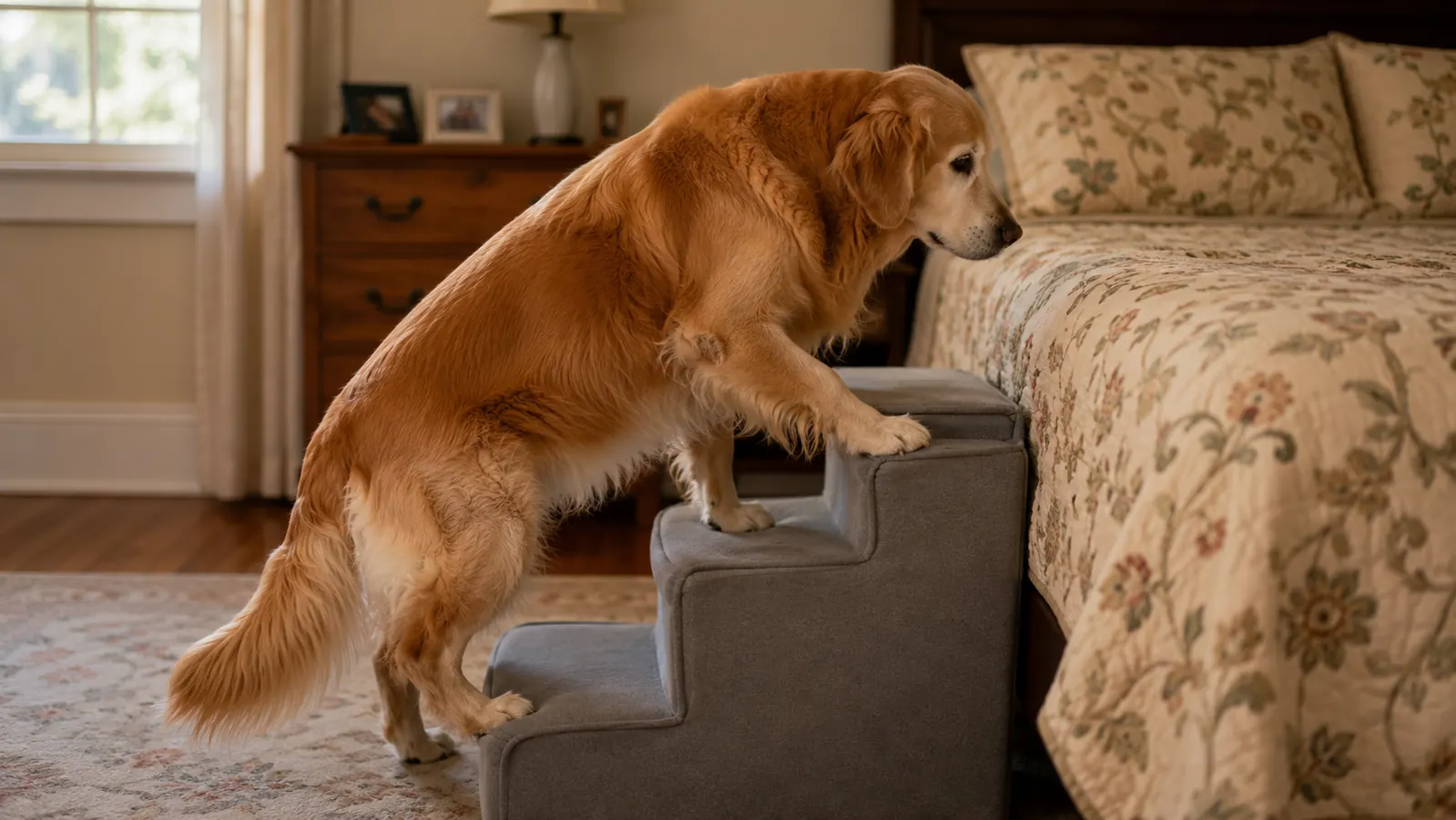
If you are trying to decide between dog stairs and a dog ramp, here is my honest short answer. For Duke, my nine-year-old Golden Retriever who has picked up some stiffness through his hips this past year, I went with the EHEYCIGA 5-Step Dog Stairs because they tuck neatly against our bed frame without eating up the walking space in my bedroom, and because Duke was already a confident step-climber before his joints started slowing him down. That said, I am not going to pretend a ramp does not have real strengths of its own. If your dog is stiffer than Duke is, rides along in the car often, or has simply never taken to climbing steps, a ramp is very likely the better choice for your home. This is not a case of one right answer. It comes down to your dog, your floor plan, and what you actually need it for.
Before I settled on the stairs, I actually borrowed a folding ramp from my daughter-in-law for about two weeks, just so I could watch Duke use both before spending money on either one. That side-by-side, not a spec sheet, is really what this whole comparison is built on. Duke walked the ramp without much hesitation, but it took up more than half the open floor between our bed and the window, and I found myself stepping around it every single night, even in the dark on my way to the bathroom. The EHEYCIGA went back into that same spot once the ramp was returned, and suddenly I had my bedroom back while Duke was still getting up onto the bed on his own, no lifting or boosting required from me.
| EHEYCIGA 5-Step Dog Stairs | Dog Ramp | |
|---|---|---|
| Price at Today's Rate | One steady price for the five-step, non-slip build | Ranges widely depending on length and material |
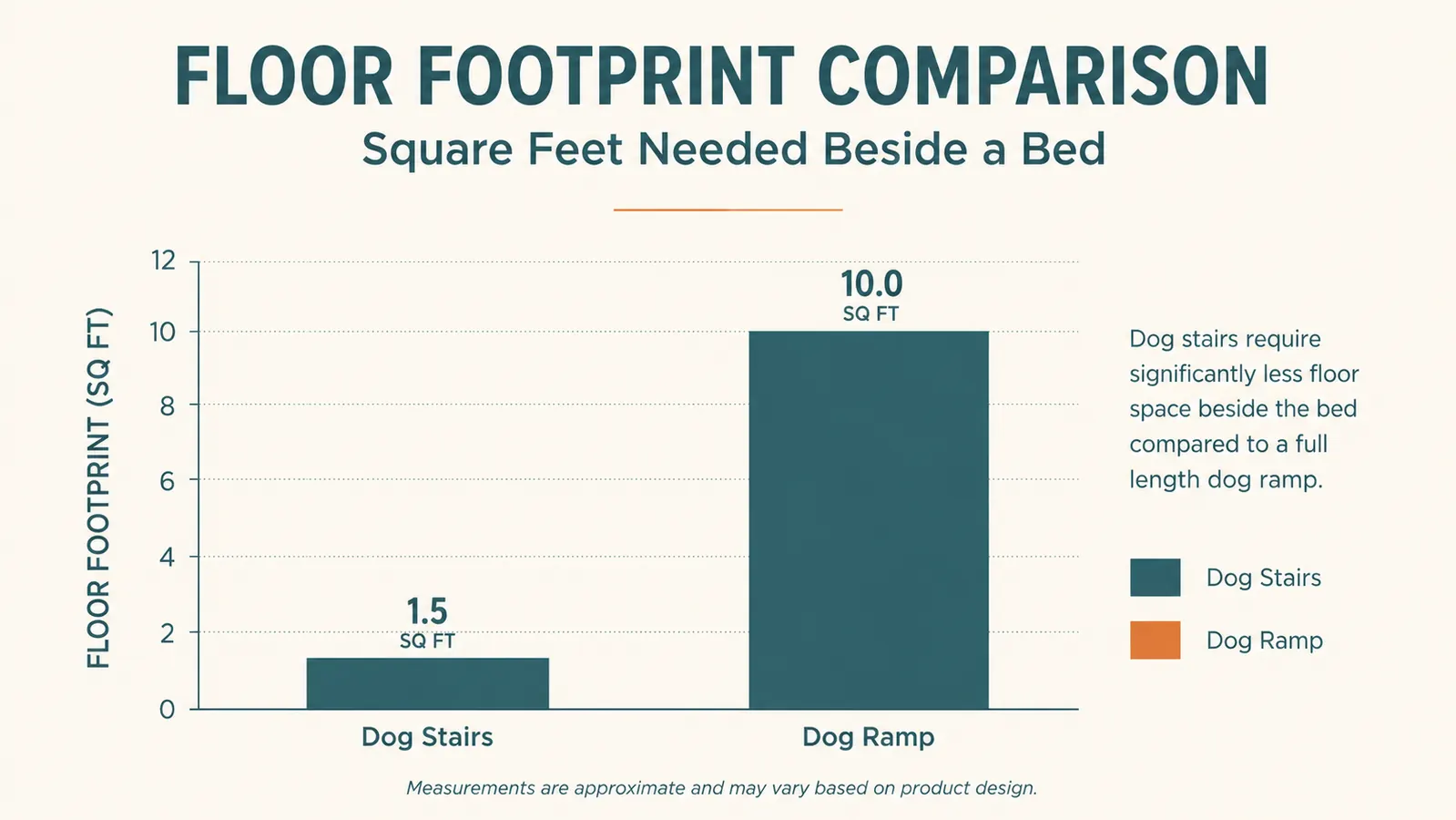
| Floor Space in a Bedroom | 22.5 inches tall, footprint about the size of a nightstand, sits flush against the bed frame | A gentle enough incline for a bed this height often needs four feet or more of length |
| Gentle on Stiff Hips | Still asks a dog to lift and extend each leg with every one of the five steps | Continuous incline with no repeated lifting motion, easier on sore joints |
| Getting a Dog Into the Car | Not practical, there is no stable way to set stairs against a tailgate | Purpose-built car ramps rest against a tailgate or bumper and fold for transport |
| Dogs Who Won't Learn Steps | Requires a dog to master an up-and-down stepping motion, some never take to it | Simpler, more natural walking motion that anxious or hesitant dogs often accept faster |
| Non-Slip Traction | Textured grip pad on every step, held up well even with damp paws | Traction varies a lot by model, some ramp surfaces get slick without a carpet overlay |
| Storage When Not in Use | One solid compact unit that nudges flush against furniture and stays out of the way | Even folding models are long and awkward, usually end up leaning against a wall |
| Stability Once in Place | Wide, flat steps with a low center of gravity, feels solid underfoot climbing or descending | Can flex or wobble slightly if not set at the correct angle against the bed |
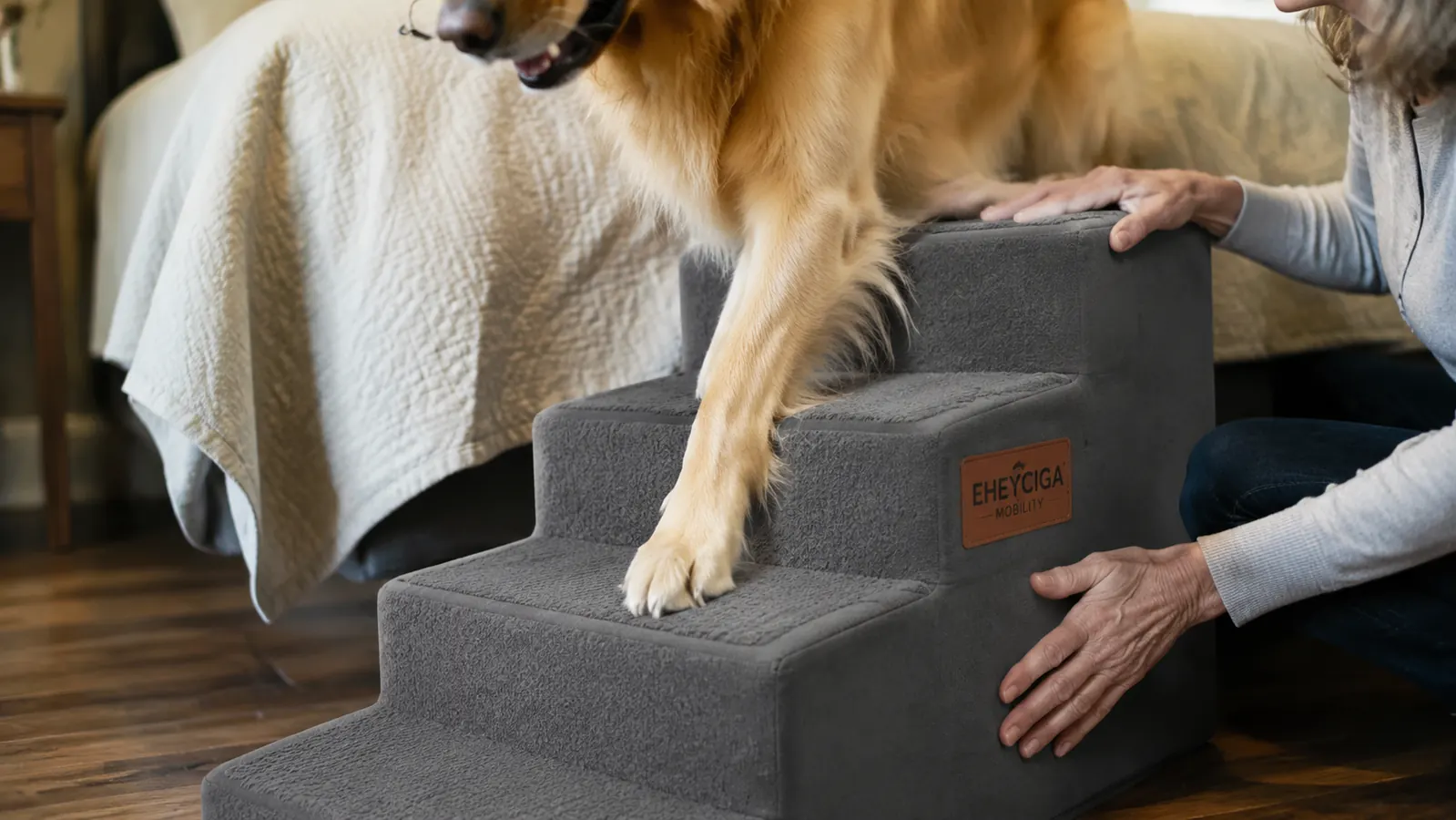
Where the EHEYCIGA Dog Stairs Win
Floor space is the honest reason I chose the stairs over the ramp for our bedroom. The EHEYCIGA stairs stand 22.5 inches tall and step up in five shallow risers, so the whole unit sits in a footprint not much bigger than a nightstand. A ramp long enough to give a stiff-hipped dog a truly gentle incline needs a lot more length than most people expect, often four feet or more for a bed this height, and in a smaller bedroom that eats up walking space fast. I measured before I bought either one, and the stairs simply fit our room in a way the ramp never did, right down to the narrow gap between my nightstand and the foot of the bed.
The non-slip surface has held up well too. Each step has a grippy textured pad, and even with Duke's nails and the occasional damp paw after a rainy walk, I have not seen him slip going up or down. Storage is another quiet win. When my daughter-in-law's ramp was not in use, it still leaned against the wall taking up space because it does not fold down small. The EHEYCIGA, by comparison, is one solid unit I can nudge flush against the bed frame and mostly forget about. For a dog like Duke who already knew how to climb steps before his hips started bothering him, the stairs asked nothing new of him. He used them confidently within the first day, and Patches has taken to napping on the bottom step in the afternoon sun, which tells me they are steady enough for a cat to trust too.
Price ended up being closer than I expected going in. The stairs sit at one steady price, and a decent ramp can cost anywhere from a little less to noticeably more depending on the length and the material, so I would not lead with price as the deciding factor either way. What actually tipped it for us was how little rearranging the stairs demanded. I did not have to move my nightstand, shift the bed away from the wall, or block the closet door to make room, the way I would have needed to with a ramp long enough to be genuinely gentle. If your bedroom is on the smaller side, that difference is worth measuring out with a tape before you buy either one.
Where a Dog Ramp Wins
A ramp is genuinely gentler on stiff joints than any set of steps, and I want to be fair about that rather than just talk my own pick up. Climbing stairs, even shallow ones, still asks a dog to lift and extend each leg with every step, which is real effort for a dog whose hips or knees are already sore. A ramp lets a dog walk up at a steady, continuous incline with no repeated lifting motion, which is part of why vets often recommend a ramp first for a dog with a diagnosed joint condition or a recent surgery to recover from. Duke's stiffness is mild enough right now that the stairs work fine for him, but if his hips get noticeably worse, I would not rule out switching to a ramp down the road, and I would not feel like I had failed him by making that change.
The car is where a ramp really pulls ahead. Stairs are simply not practical for loading a dog into an SUV or a truck bed, there is nowhere stable to set them against a tailgate, but a folding ramp does that job well and several models are made specifically for vehicle height. If you take your dog along in the car often, especially a dog who has gotten too heavy or too stiff to jump up on their own, a ramp is worth having even if you also keep stairs by the bed. A ramp is also the better answer for a dog who simply never learns to climb steps. Some dogs, particularly ones who are anxious or visually impaired, never get comfortable with the up-and-down motion of stairs no matter how much you coax them, and a ramp asks for a much simpler, more natural walking motion instead.
There is also the matter of how a dog's confidence changes with age. Duke handles the stairs fine right now, but I have talked to enough people at the dog park to know that a dog's comfort with steps can shift over a year or two in ways you do not see coming. A neighbor of mine has an older Beagle who used stairs happily for years, then one winter simply stopped trusting them, seemingly overnight, and switched to a ramp without any fuss. If you notice your own dog starting to hesitate at the top of a set of stairs, pacing back and forth instead of climbing, that hesitation is worth listening to rather than working around.
Small footprint, steady steps, no rearranging the bedroom
If your dog still climbs stairs just fine and you need something that will not swallow your floor space, this is the one I keep by Duke's side of the bed.
Amazon Check Today's Price on Amazon →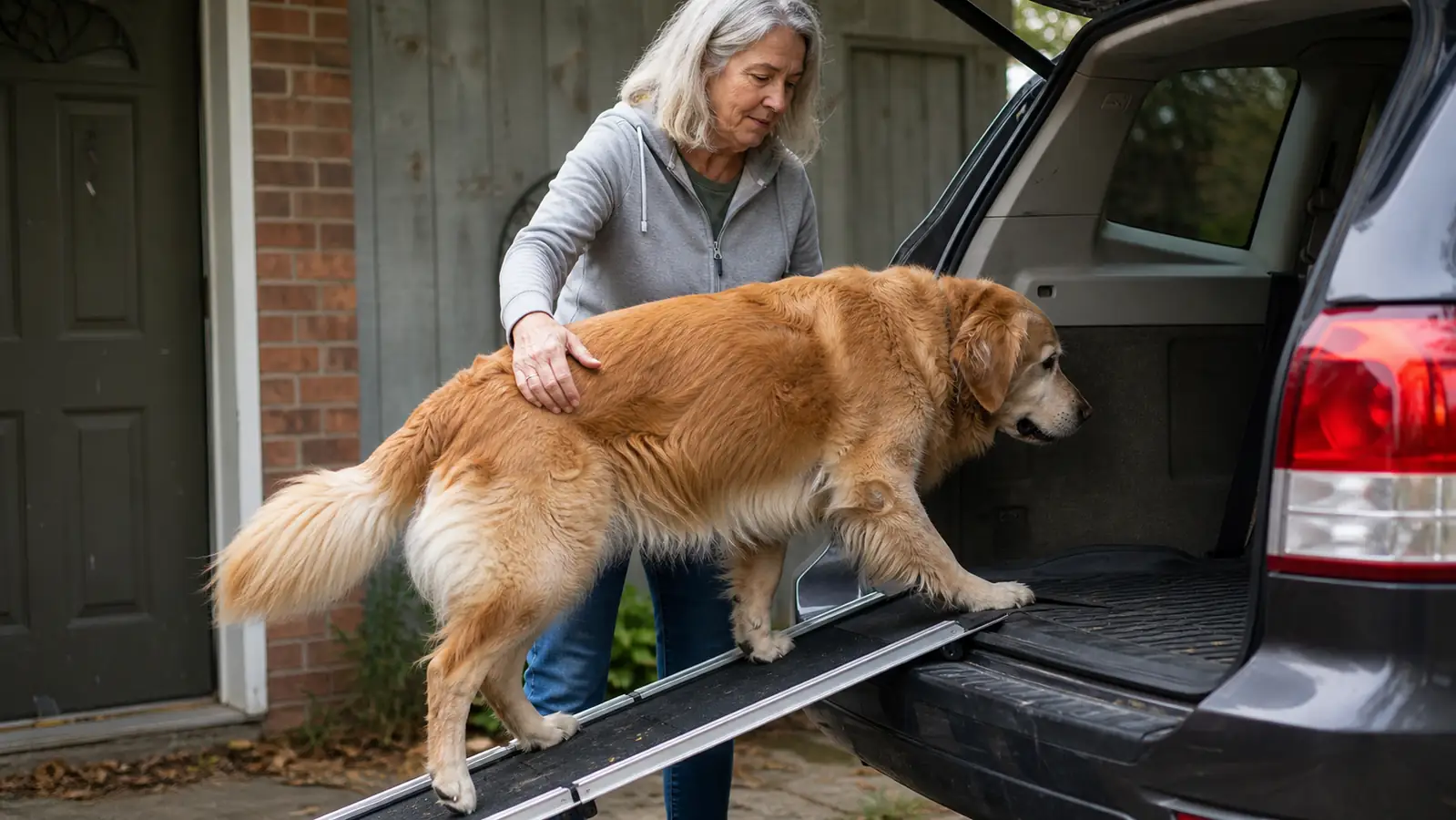
Who Should Buy Which
If your dog already climbs steps without much trouble and you are mainly trying to protect a small bedroom or living room from a leggy contraption on the floor, the EHEYCIGA stairs are the practical choice. They ask almost nothing of a dog who has some step experience already, and the smaller footprint makes them realistic for rooms that a full-length ramp simply will not fit into. That describes our house pretty closely, which is why the stairs are what sit by Duke's side of the bed today.
If your dog has a diagnosed joint condition, has had recent surgery, is noticeably stiffer than Duke, or needs help getting into the car on a regular basis, I would point you toward a ramp instead, even though the stairs are what I am recommending for our own bedroom. The same goes for a dog who has already tried steps and simply will not use them. There is no prize for forcing a dog to learn something that is not working for their body or their temperament. Buy the tool that fits the dog in front of you, not the one that photographs tidier next to the bed.
It is also worth thinking about whether you might need both eventually. Plenty of households end up with stairs by the bed for everyday use and a folding ramp tucked in the trunk of the car for trips to the vet or a weekend visit somewhere. That is not overkill, it is just matching the right tool to two different jobs, one indoors and one on the road. I am not there yet with Duke, but I keep the option in the back of my mind rather than assuming one purchase has to cover everything forever.
For us, with a dog who still climbs steps just fine and a bedroom that cannot spare four extra feet of floor, the EHEYCIGA earned its spot. Yours may land differently, and that is completely fine. If you are not sure which side your own dog falls on, watch how they handle a single low step somewhere else in the house, a porch step or a curb on a walk. A dog who takes that in stride is usually a good candidate for stairs. A dog who hesitates, favors a leg, or avoids it altogether is telling you something worth listening to, and that dog is probably better served by a ramp.
The compact fix that gave Duke his bed back
No wobble, no wasted floor space, and a dog who was climbing it confidently by day one. Here is the exact set I use.
Amazon Check Today's Price on Amazon →