
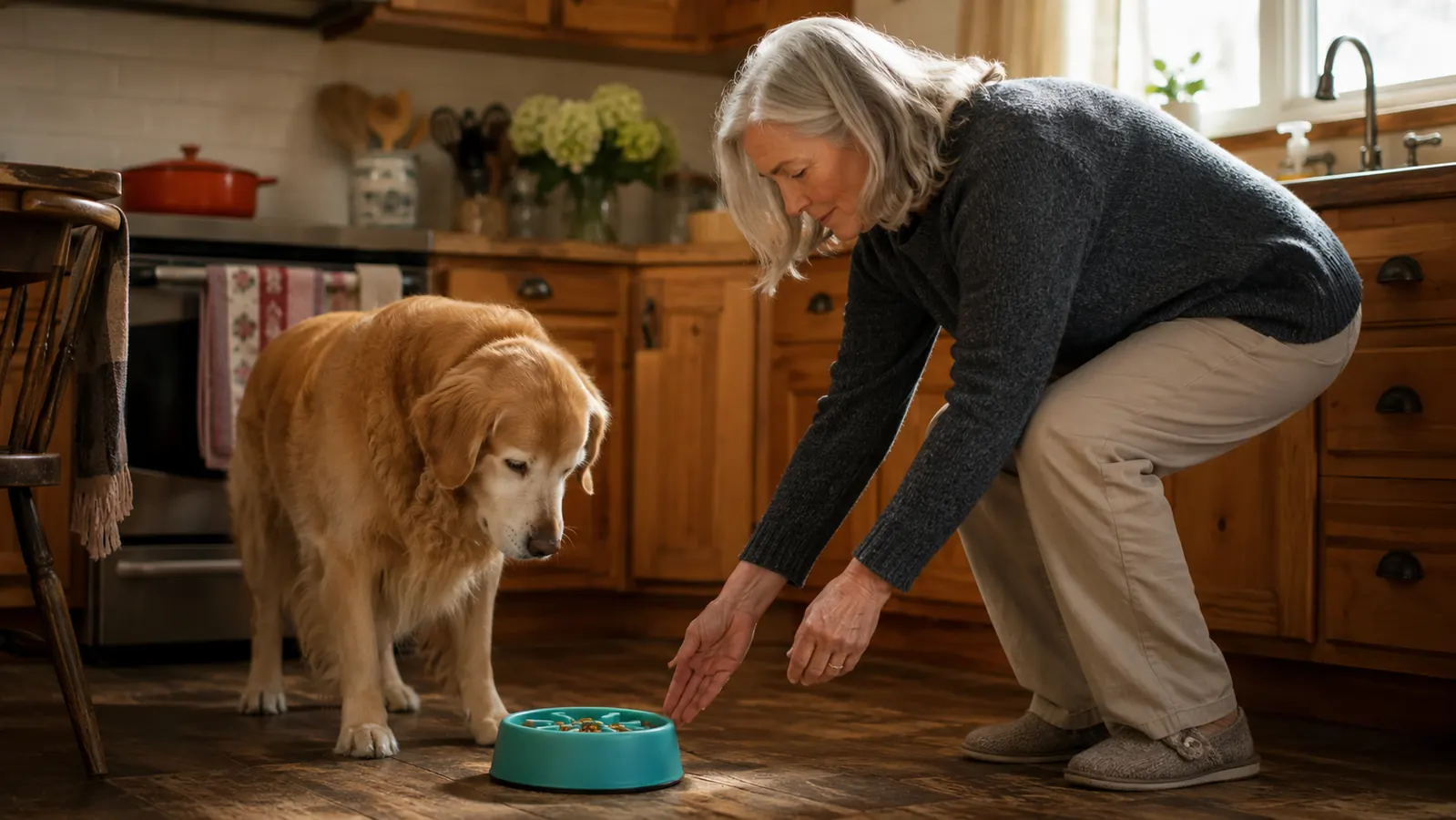
Duke used to empty his bowl in under a minute. I mean that almost literally, I could set his food down, turn to put the bag away, and turn back around to an already-clean bowl and a dog looking up at me like nothing had happened. It wasn't cute for long. He'd gag a little afterward, sometimes bring some of it right back up, and he got so worked up during mealtime that he'd pace and whine the second he heard the pantry door open. The Outward Hound Fun Feeder Slo Bowl he eats out of now is the reason that stopped, but it took me a while to get there. My vet mentioned that fast eating, especially in a bigger, deep-chested dog like a Golden Retriever, is worth taking seriously, since it can be uncomfortable and in some cases is linked to more serious digestive trouble. She wasn't alarmed, just direct about it being something to manage rather than ignore.
What actually slowed Duke down wasn't a training trick or some complicated feeding schedule. It was a slow feeder bowl, the kind with raised ridges built into the bottom so a dog has to work around them instead of just tipping the bowl into his mouth in one motion. I want to walk you through exactly how I introduced ours, step by step, because doing it wrong the first week nearly convinced me it wasn't going to work at all.
The Bowl That Finally Slowed Duke's Mealtime Down From One Minute to Eight
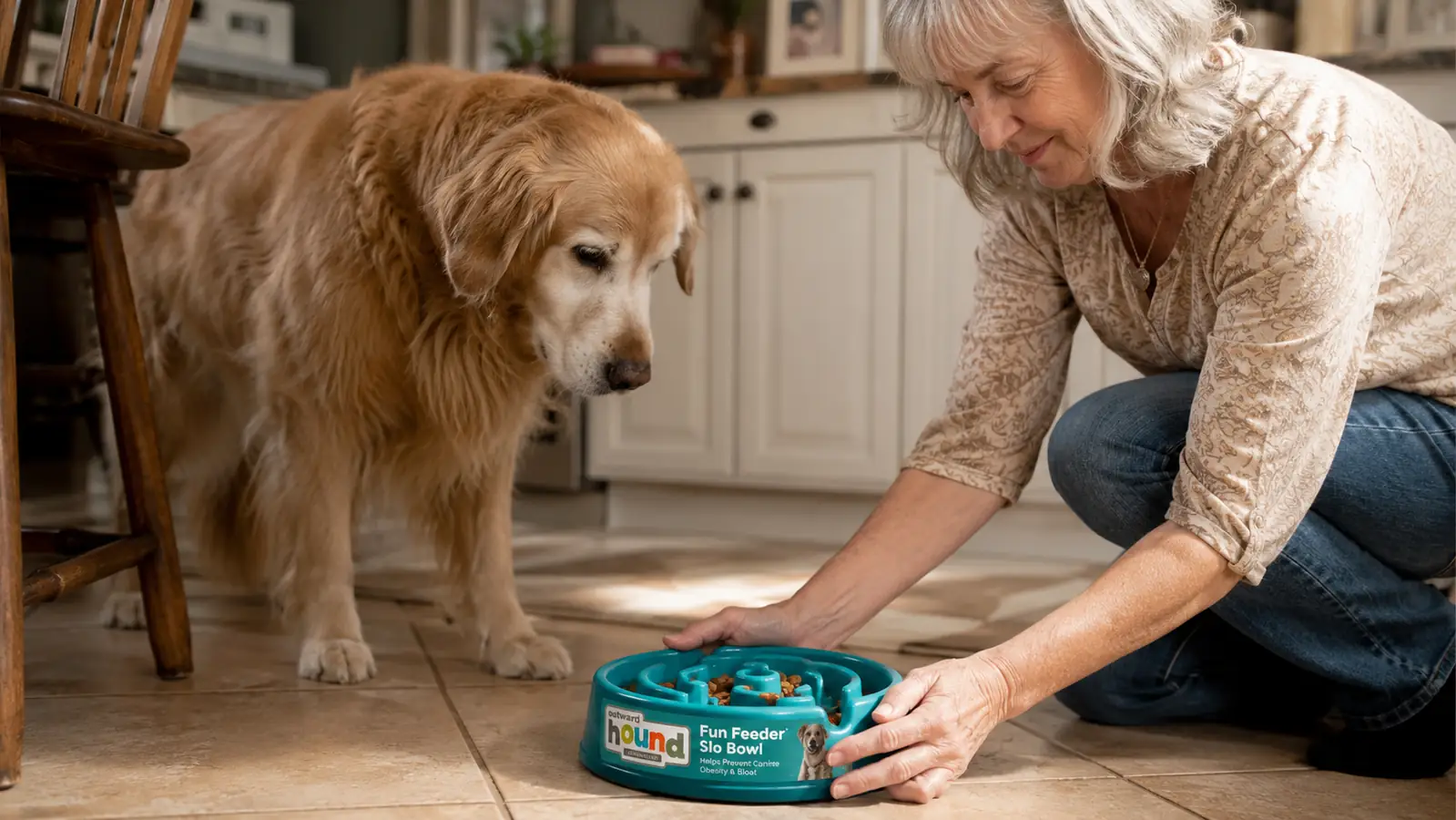
The one I use is the Outward Hound Fun Feeder Slo Bowl. It has a raised ridge pattern that forces a dog to eat around it instead of gulping everything down in one go, and the turquoise one has held up fine to Duke's enthusiasm for years.
Amazon Check Today's Price on Amazon →Step 1: Understand Why Your Dog Is Gulping Before You Try to Fix It
Before I bought anything, I spent a little time figuring out why Duke ate the way he did. For some dogs it's competition, if there's another pet in the house, or even if there was one at some point in their past, fast eating can be a leftover habit from feeling like the food might disappear. For other dogs it's simply excitement, or a food bowl placed somewhere that feels rushed, like right by a busy doorway.
Duke doesn't share the house with another dog, so for him I think it was mostly excitement and habit built up over years of the same routine, bowl down, food gone, done. Patches, my cat, keeps her distance from his bowl entirely, so competition wasn't really the driver in our house. Knowing the likely cause doesn't change the fix much, a slow feeder bowl helps with almost every version of fast eating, but it did help me stop blaming myself for somehow training him to eat that way.
If your dog's gulping seems to have started suddenly, or comes with other changes like weight loss, vomiting that isn't just the occasional bit of undigested food, or a swollen or hard looking belly, that's a conversation for your vet, not something to solve with a bowl alone. A slow feeder bowl is a mealtime tool, not a medical fix, and any real health concern deserves an actual exam.
Step 2: Pick a Slow Feeder Bowl Sized for Your Dog, Not Just the First One You See
This is where I almost got it wrong the first time. I nearly grabbed a small feeder made for little dogs, thinking any ridge pattern would do the job. For a dog Duke's size, that would have been a mistake, a bowl sized too small for a large breed can be tipped and dragged around, which honestly speeds a dog back up because they're chasing the bowl instead of working through the ridges calmly.
I ended up with the large four cup Outward Hound slow feeder bowl, sized right for a Golden Retriever, with a heavier, wider base that doesn't slide around on my kitchen floor while Duke is eating. The ridge pattern in that one is a maze style, spiraling grooves that make him navigate his way around the bowl rather than just plowing straight through. If you've got a smaller dog, a smaller sized slow feeder bowl with a tighter ridge pattern usually works better, since a large bowl can feel overwhelming and some small dogs will just eat around the ridges instead of through them.
Material matters too. I went with a non-slip base for the same reason I wanted the right size, a bowl that stays put during a meal keeps a dog's attention on eating slowly rather than on chasing it across the floor. Look for something dishwasher safe as well, because a slow feeder bowl with deep ridges collects more residue than a flat bowl, and nobody wants to hand-scrub grooves every single day. My Outward Hound goes through the top rack twice a week, and the ridges have held up fine after years of that without cracking or losing their shape.
Step 3: Introduce the Slow Feeder Bowl Gradually, Not Cold Turkey
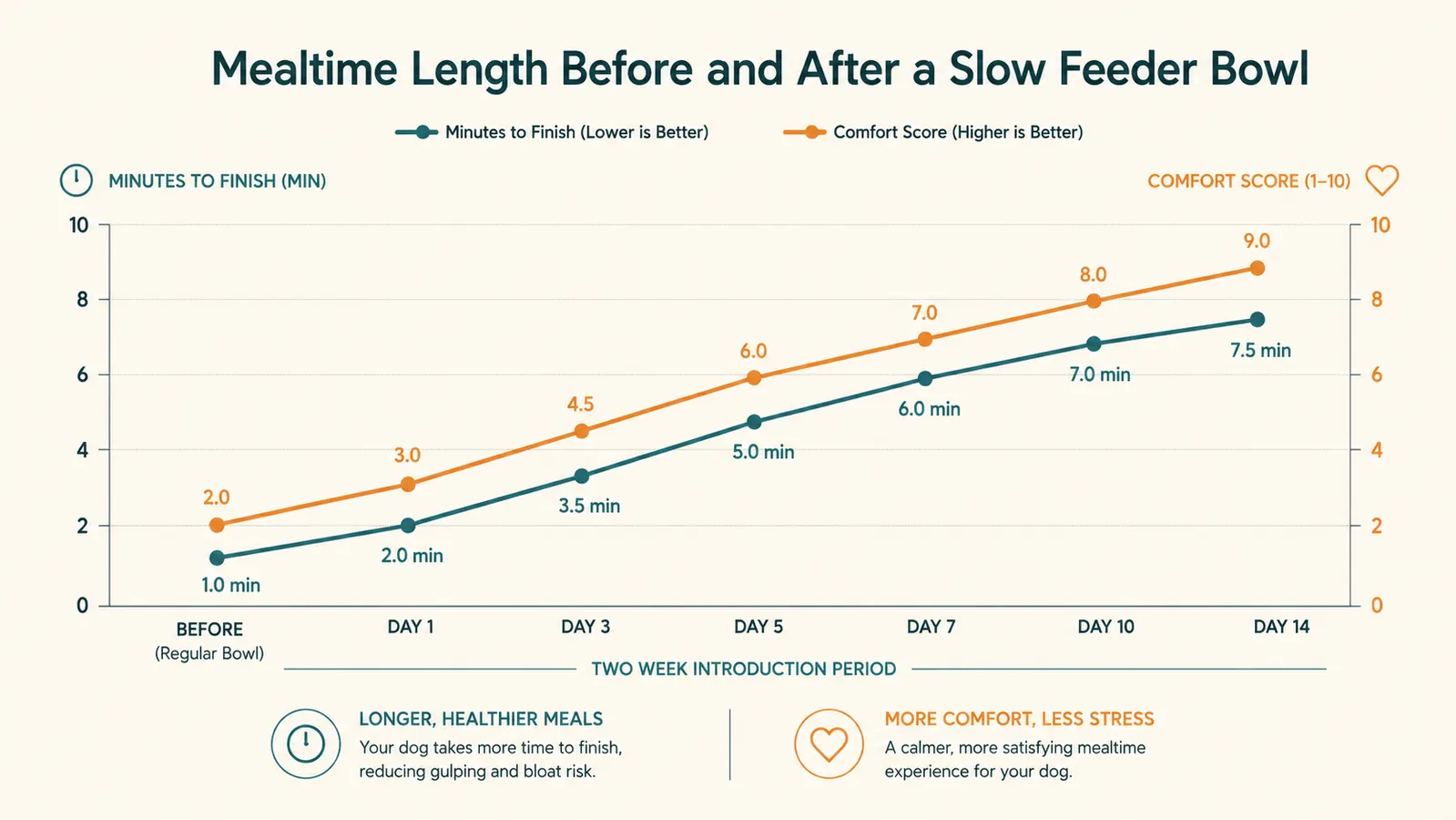
The first time I set Duke's food down in the new bowl, he stared at it like I'd played a trick on him. He pawed at it, tried to flip it, and got frustrated enough that he barely ate a third of his meal before wandering off. I panicked a little and almost went back to his old flat bowl. I'm glad I didn't, because what I actually needed to do was ease him into it instead of expecting an instant adjustment.
For the first few days, I mixed his regular kibble with a small amount of wet food or warm water right in the Outward Hound. The extra scent and texture kept him engaged and interested even while he was figuring out the ridges. I also kept portions a little smaller those first few meals, since a frustrated dog giving up on a full bowl is worse than a smaller amount actually finished.
By about day four, Duke had mostly figured it out on his own. Dogs are smarter about this than we give them credit for. Within a week he was navigating the ridge pattern without the added moisture, and within two weeks it was just his normal bowl, no fuss, no pawing at it. If your dog seems to be really struggling past the first week, it's worth trying a slow feeder bowl with a simpler, shallower ridge pattern rather than pushing through with one that's clearly too advanced for where they're starting out.
Step 4: Watch How Your Dog Handles It and Adjust as Needed
Once Duke was used to the bowl, I still paid attention for a couple of weeks, mostly out of habit but also because it's worth confirming the slow feeder bowl is actually doing what you want. I watched for two things mainly, whether he was still gulping in bursts around the ridges instead of steadily working through them, and whether he seemed frustrated rather than just slowed down.
There's a real difference between a dog eating slower and a dog fighting the bowl. Slower eating looks like steady, methodical bites, maybe pausing here and there. Fighting the bowl looks like frantic pawing, flipping it over, or trying to lick it clean from an angle that skips the ridges entirely. Duke had a couple of days of the second kind of behavior before settling into the first, and that's normal. If it doesn't settle after a couple of weeks, a different ridge pattern, some feeders have a spiral, others have separated compartments, might suit your particular dog better than the one you started with.
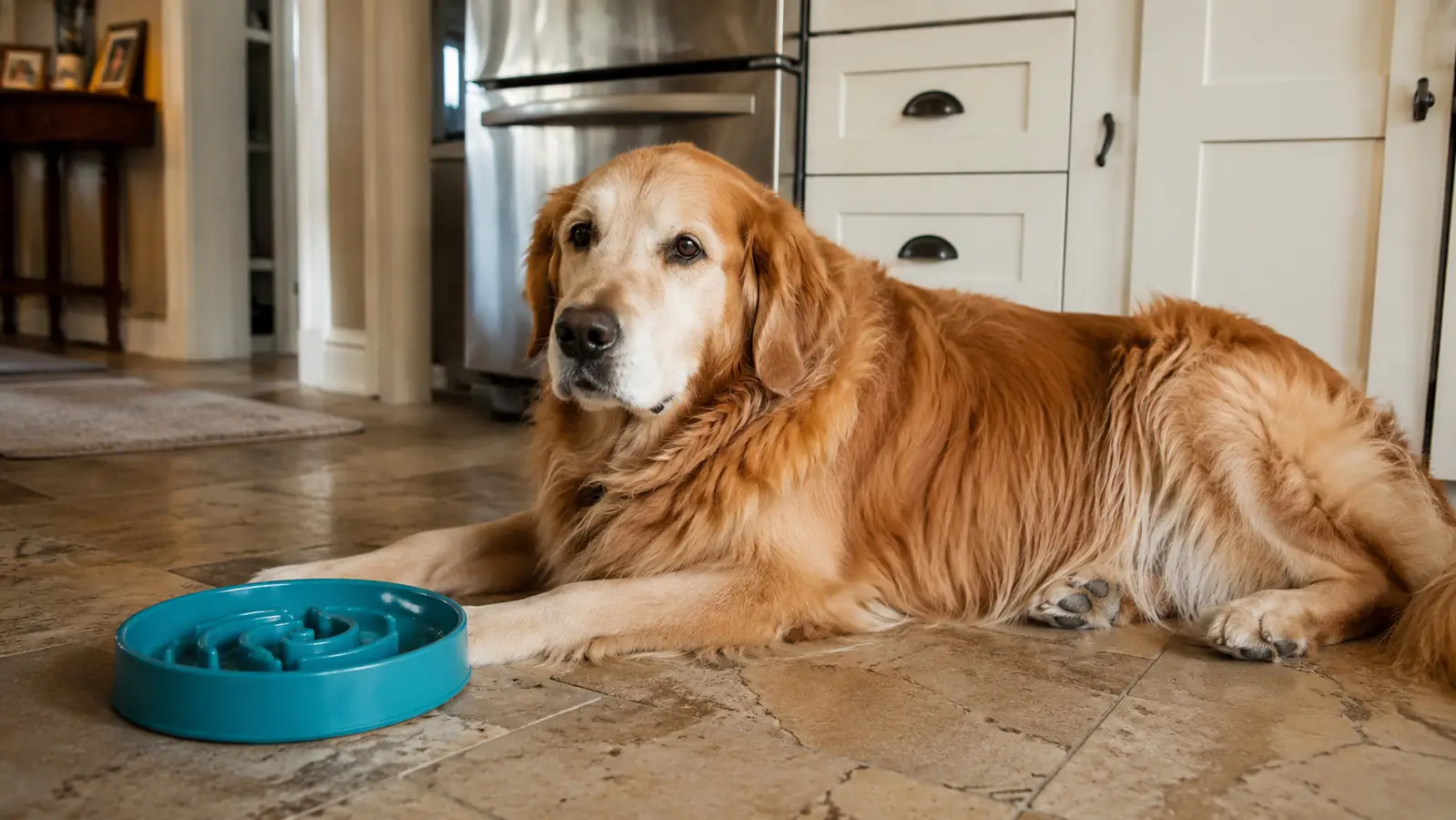
I also keep an eye on whether Duke seems more comfortable after meals now compared to before. Less gagging, less pacing right after he eats, more of him just settling down on the kitchen floor a few minutes later like nothing happened. That was the real proof for me that the Outward Hound was working, not just that his meal took longer, but that he seemed genuinely more at ease once it was done.
Step 5: Build a Consistent Routine Around Slow Feeding
The slow feeder bowl does most of the work, but the routine around it matters too. I feed Duke at the same two times every day now, morning and early evening, in the same spot in the kitchen, away from the back door where the grandkids come running through on weekend visits. A calmer, more predictable environment seems to keep him from reverting to that frantic, rushed way of eating even on busy days with a full house.
I also stopped free-feeding entirely, meaning I don't leave food out all day for him to graze on. Set mealtimes with the slow feeder bowl gave the whole routine more structure, and honestly it made cleanup simpler too, one bowl to rinse twice a day instead of a bowl sitting out collecting dust and the occasional curious visit from Patches.
If your household is busy on weekends the way mine is, try to keep the location and timing steady even when there's extra noise and extra people around. Duke's Outward Hound goes in the same corner whether it's a quiet Tuesday or a Saturday full of grandkids, and that consistency has done almost as much for his mealtime calm as the bowl itself.
A Mistake I Made Early On
For the first couple of weeks I kept peeking over my shoulder while Duke ate, half expecting him to somehow crack the code and go back to gulping. That kind of hovering made him nervous, and a nervous dog tends to eat faster, not slower, because he could feel me watching and rushed to get it over with. Once I started walking away and letting him work through the slow feeder bowl on his own, without an audience, he actually settled into a steadier pace much faster than when I was standing there monitoring every bite.
I also made the mistake of switching brands of kibble at the same time I introduced the bowl, which made it hard to tell whether the slow eating pace was from the new bowl or the new food taking some getting used to. If you're planning both changes, it's worth spacing them out by a week or two so you actually know what's working and can troubleshoot properly if something isn't going smoothly.
What Else Helps Alongside a Slow Feeder Bowl
A few small things made the transition smoother for us beyond the bowl itself. I split Duke's daily food into two smaller meals instead of one large one, since a smaller portion is naturally less tempting to inhale all at once. I also avoid exercise or excited play right before and right after meals, giving him a little quiet time on either side, which several vets have told me is a reasonable habit for larger dogs regardless of how fast they eat. And I keep his slow feeder bowl on the ground rather than raised on a stand, since raised feeders are a separate topic your vet may have their own opinion on depending on your dog's breed and history. If gulping continues to be a struggle even with a slow feeder bowl in place, or if you ever notice symptoms that worry you, that's always worth a call to your vet rather than guessing at home.
I'm not standing over Duke during mealtime anymore, worried about what happens next. He just eats, calmly, and then he settles down like a dog who actually enjoyed his dinner.
A Simple Bowl Swap Turned Frantic Mealtimes Into Calm Ones
If your dog eats like the bowl might get taken away any second, the fix usually isn't more training, it's a slow feeder bowl built to slow the pace down naturally. This is the one I still use every single day.
Amazon Check Today's Price on Amazon →