
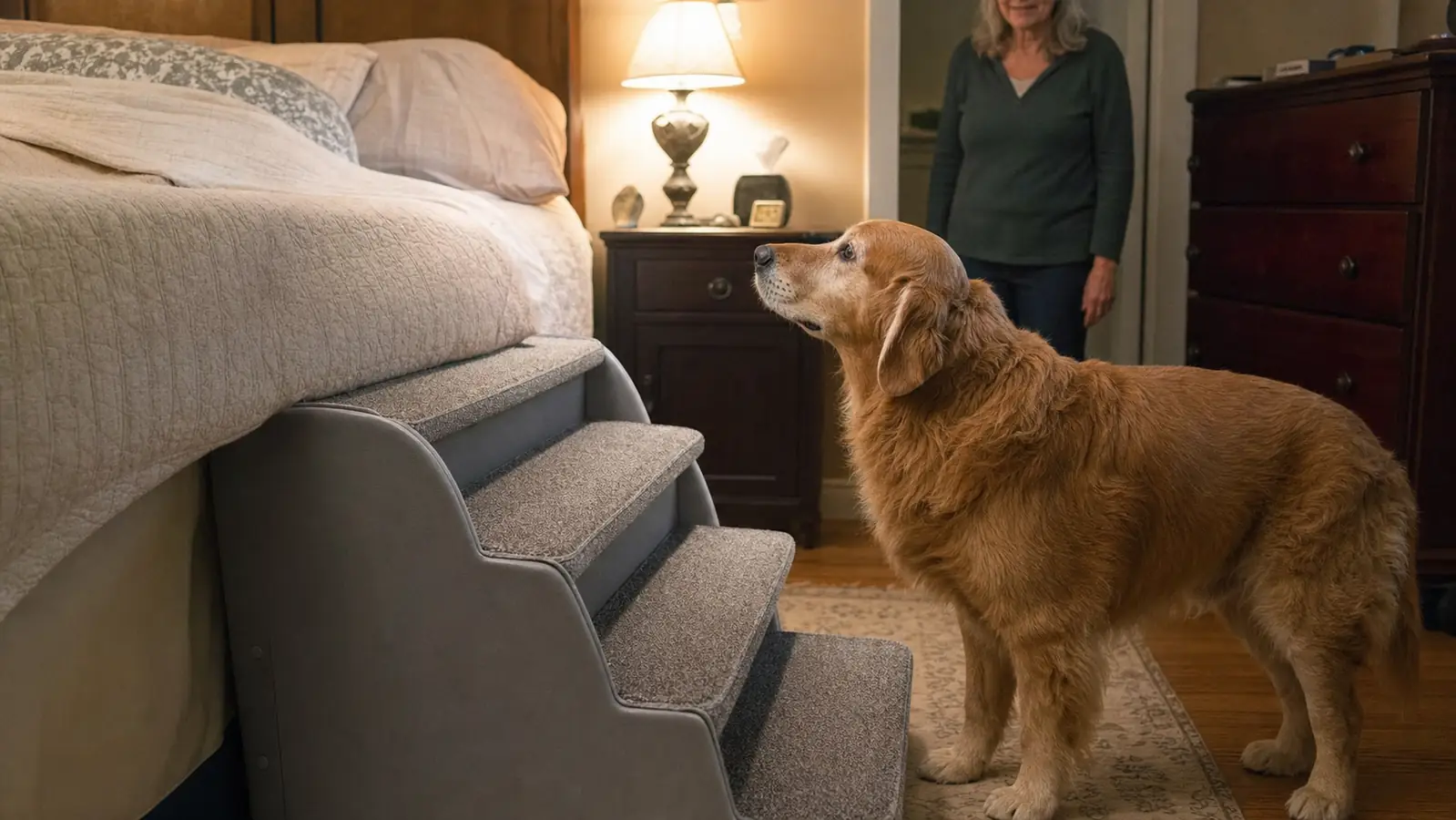
If your dog has suddenly stopped jumping onto the bed or the couch, please call your vet before you buy anything. A sudden change is different from a slow one. It can mean pain somewhere you can't see, and a set of dog stairs is not going to fix a torn ligament or a bad disc. What a set of dog stairs like the EHEYCIGA can do, once your vet has ruled out something urgent, is take the leap out of an aging dog's evening so his joints aren't absorbing that landing every single night.
Duke is nine now, my Golden Retriever, and he still wants to sleep pressed against my legs the way he has since he was a puppy. But over the last year or so I've watched him pause at the foot of the bed longer than he used to, doing that little calculation dogs do before a jump. He has some stiffness in his hips, nothing dramatic, the kind of thing our vet called normal wear for a dog his size and age. Nothing that needed medication, but enough that I didn't want him launching himself up onto a mattress every night for the next five years. That's the whole reason I started looking into dog stairs in the first place.
Give him a way up that doesn't ask his hips to do the jumping
This is the 5-step set of dog stairs I use for Duke, wide enough for a big dog's paws and stable enough that it doesn't wobble when he shifts his weight mid-climb.
Amazon Check Today's Price on Amazon →Here's what nobody tells you when you first bring a set of dog stairs home: most dogs do not use them on the first try. Duke sniffed the EHEYCIGA, walked around it twice, and then hopped up onto the bed the old-fashioned way, like the stairs were furniture I'd rearranged for no reason. That's normal. A dog who has been jumping his whole life doesn't automatically understand that a staircase is meant for him. Teaching him takes about a week of short, boring, repetitive little sessions, and that's really the whole guide.
I want to say up front that patience matters more than any product will. Dog stairs only work if the dog trusts them, and trust doesn't come from setting a new object down and hoping for the best. It comes from the same small, repeated wins you'd use to teach any new habit. Go slower than feels necessary. I promise it saves time in the long run. Rushing a nervous older dog usually means starting over a few days later, which takes longer than just going slow the first time.
Step 1: Let him meet the dog stairs with zero pressure
Before you ask for a single step, just let the dog stairs sit in the bedroom for a day or two. Don't lead him to them, don't point at them, don't make it a moment. Duke ignored ours completely the first evening, and that was fine. A wary older dog needs the object to become boring furniture before it becomes something he's willing to put his paws on.
If your dog is naturally nervous around new objects, you can speed this along by tossing a treat near the base of the dog stairs at random times during the day, not asking anything, just letting good things happen close to it. By the time you start real training, the stairs shouldn't be a novelty anymore, just another thing near the bed that occasionally means a treat shows up.
Step 2: Reward one paw on the bottom step
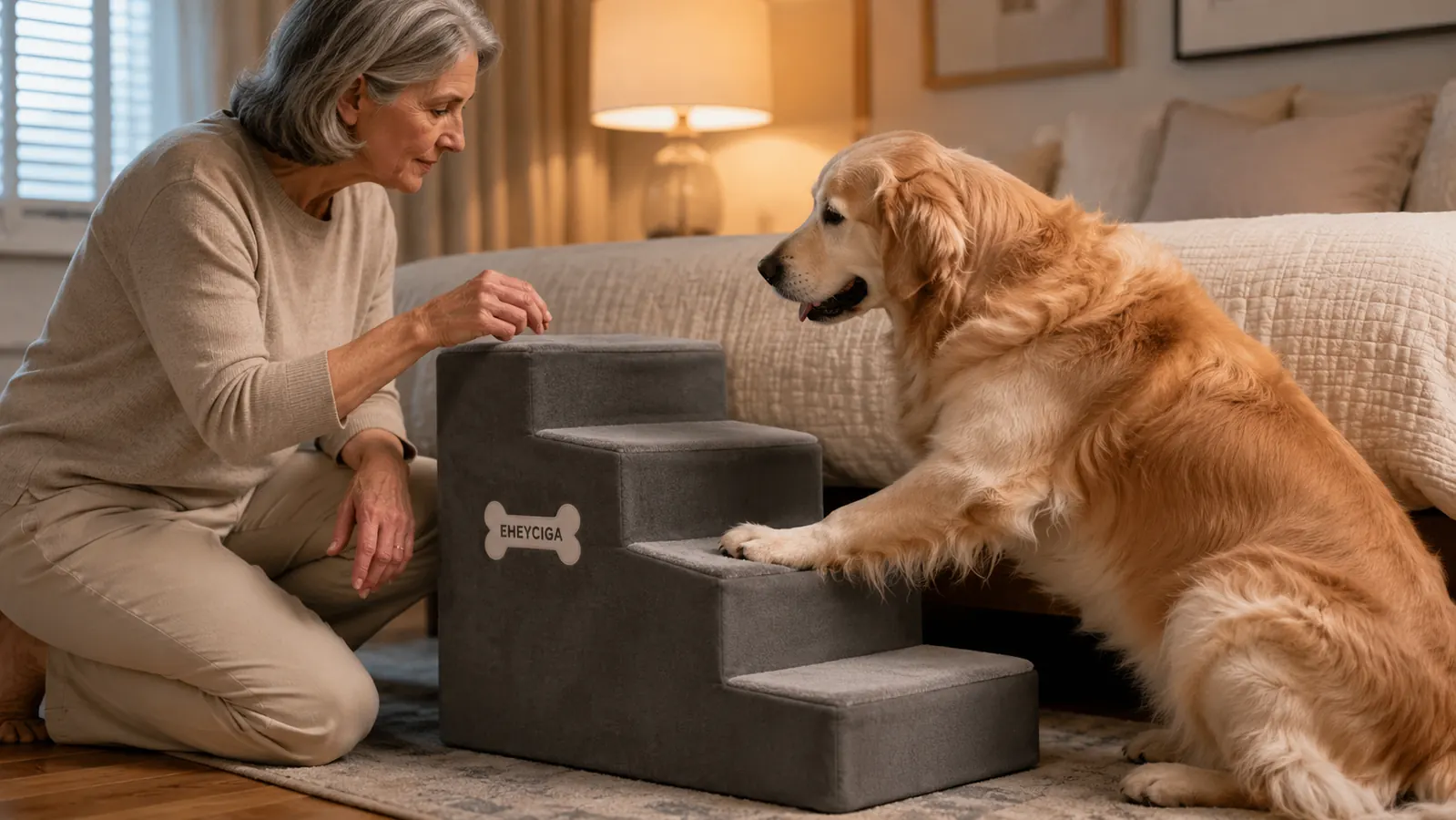
This is where the actual training starts, and it's smaller than you'd think. Hold a treat right at nose height above the first step, not up at the bed, just the first step. The second a paw touches it, even for a second, mark it with a happy word like "yes" and give the treat right away. The timing of the word matters more than the treat itself, since it tells him exactly which movement earned the reward. Duke needed maybe six repetitions of this before he stopped hesitating and started offering the paw on his own.
Keep this session under three minutes. I know it's tempting to keep going once he's getting it, but older dogs, especially ones with any hip stiffness, tire out mentally faster than they let on. End on a win and try again later that day rather than pushing for ten more minutes. Two or three short sessions a day beat one long one every time with dog stairs training, at least in my experience with Duke.
Step 3: Lure him one step at a time, never the whole staircase at once
Once he's comfortable with step one, hold the treat a little higher and a little further, so he has to place a second paw on step one or step two to reach it. Go slow here. The mistake I made early on was holding the treat too far ahead, which just made Duke want to jump over the EHEYCIGA entirely instead of climbing it, which defeats the whole point of having them there.
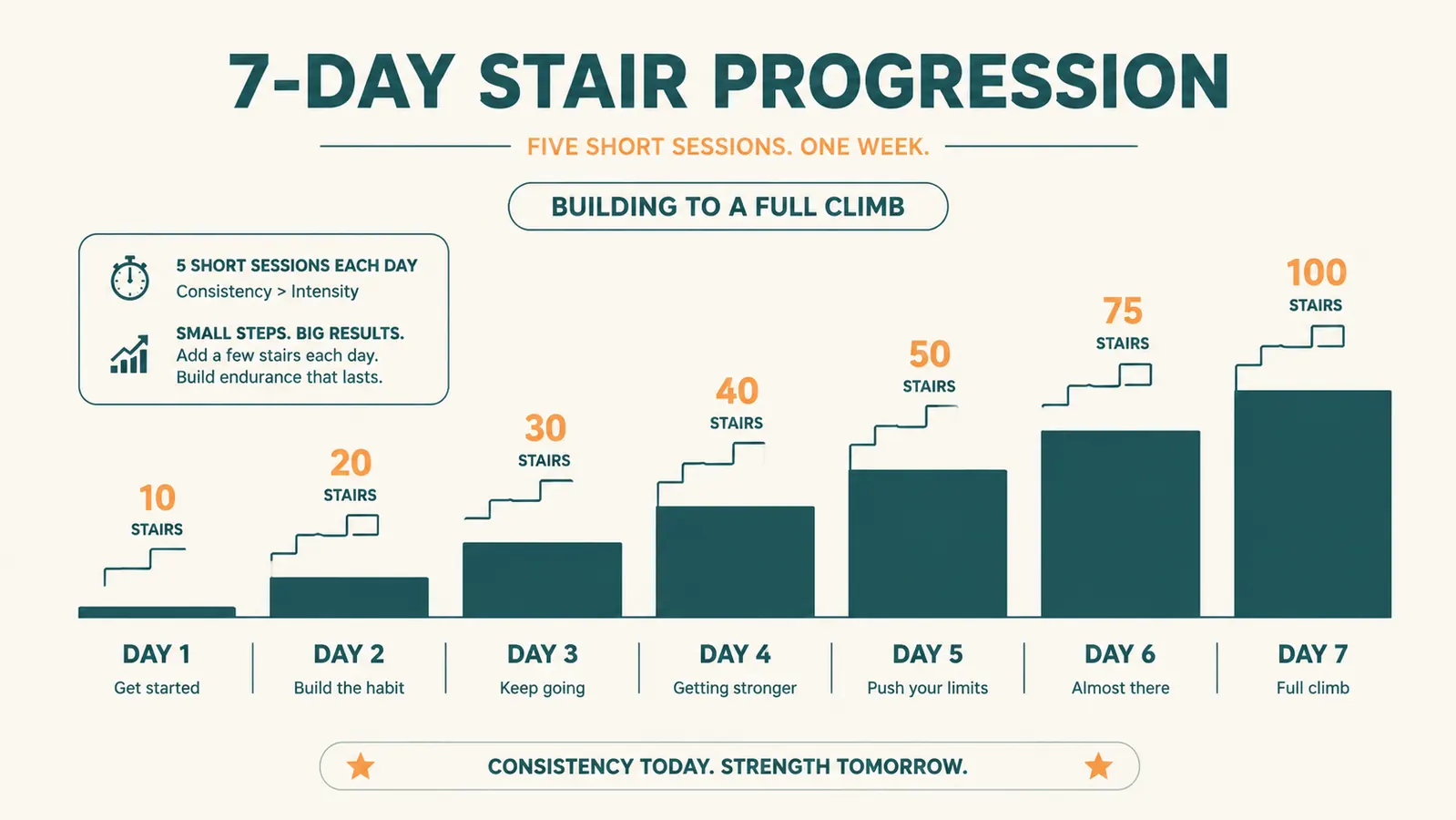
Work up one step at a time across several short sessions, not one long one. It took Duke about four days of two or three brief sessions each to go from touching step one to climbing all five steps in a row. Every dog is different. A smaller or younger dog might get there in two days. A dog with more joint discomfort might need two weeks, and that's fine too. There's no prize for finishing dog stairs training fast, and pushing a stiff-hipped older dog to hurry defeats the whole purpose of buying the stairs to begin with.
Small, soft treats work better than crunchy ones here, mostly because they don't take long to chew and break momentum. I used little pieces of plain boiled chicken with Duke since he'll do almost anything for it, but a soft training treat from the pantry works just as well if your dog isn't picky.
Step 4: Practice going down just as much as going up
This step gets skipped constantly and it shouldn't be. Going down is honestly harder for a lot of dogs because they can't see their back feet placement as easily, and a dog who's confident going up but scared going down will often just leap off the bed anyway, which puts you right back where you started. Lure him down the same slow, one-step-at-a-time way, treating at each step, until going down the dog stairs feels as ordinary as going up them.
Whatever you do, don't carry him up and set him down at the top to skip this part. It feels like a shortcut, but it teaches him nothing except that the bed is reachable without the stairs, and it will not help him learn to use them on his own. It also means you'll be lifting a large dog every single night indefinitely, which is exactly the situation dog stairs are supposed to save your back from.
Step 5: Fade the treats and let it become his normal routine
Once he's climbing up and down without hesitation, start rewarding every other successful climb instead of every single one, then every third, until the treat isn't the point anymore and the routine has just become how he gets to bed. Duke is fully there now. He walks straight to the EHEYCIGA at bedtime the same way he used to walk straight to the edge of the mattress to jump.
Some evenings I still tuck a treat in my pocket out of habit, mostly because it's become part of our little routine rather than because he needs the bribe anymore. Watching him choose the stairs on his own, without any coaxing, is honestly one of the small satisfying things about getting older dogs through a change like this.
The point isn't to make him use the dog stairs. It's to make the stairs feel like the obvious way up, the same way jumping used to.
What Else Helps
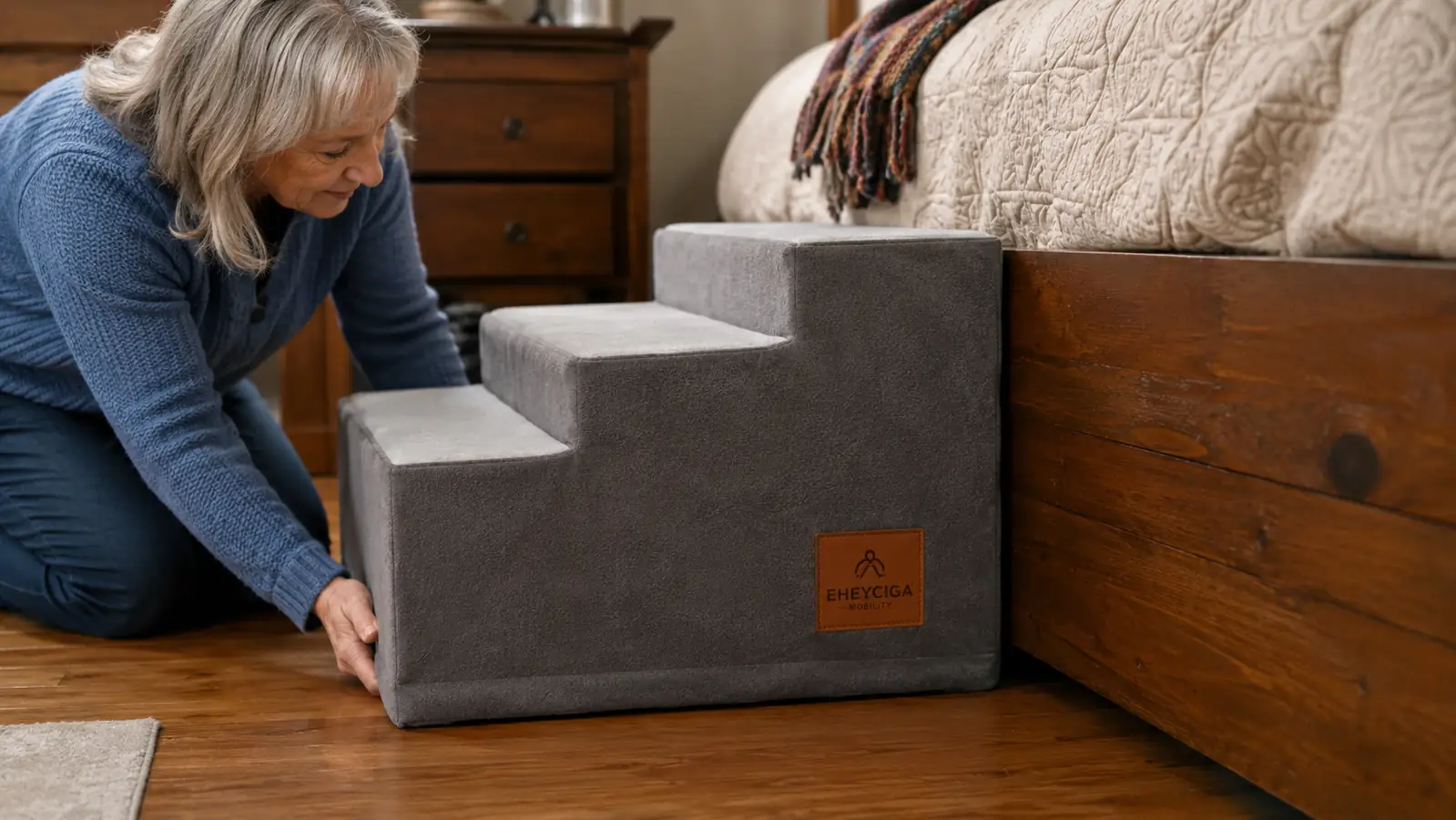
Placement matters more than people expect. Push the EHEYCIGA flush against the bed frame so there's no gap for him to misjudge, and if your floor is hardwood or tile, make sure the base has enough grip that it can't slide out from under him mid-step. I lost count of how many nights I nudged ours back into place before I finally wedged it snug against the bed frame for good. A set that shifts even an inch under a big dog's weight will undo months of confidence-building in one bad step, and a spooked dog may refuse the stairs entirely after a scare like that.
It also helps to keep the lighting decent during training. Duke was noticeably more confident climbing the dog stairs when the bedroom lamp was on than when we tried it in near-dark, which makes sense since he's judging step depth with his eyes as much as his memory. Once the habit was solid, the lighting stopped mattering as much, but early on it made a real difference in how quickly he'd commit to a step.
If he backslides after a good week and suddenly hesitates again, don't assume he's being stubborn. A missed step, a slip, or even just a sore day can make a dog cautious again for a night or two. Go back to shorter, easier sessions rather than pushing through it, the same way you would if he were just learning. Patches, our cat, never needed a lesson in any of this since she can still hop up onto the headboard without a second thought, but a nine-year-old, seventy-plus-pound dog is a different story entirely.
I'll also say the honest thing that doesn't get said enough. A set of dog stairs parked next to the bed is a trip hazard for the humans, not just a help for the dog. I've clipped my shin on ours more than once getting up at 2am, and with grandkids sleeping over most weekends, I keep a small nightlight near the bed so nobody, two-legged or four-legged, catches a foot on the steps in the dark. It's a small thing to plan around, but it's worth mentioning since most guides only talk about the dog's side of this.
Once the routine is solid, it's still worth a quick check every few weeks. Give the EHEYCIGA a gentle push to make sure nothing has loosened, and wipe down the treads if they've picked up dust or fur, since a slick step is the last thing you want under a dog who's finally trusting the climb. Duke's stairs live in the same spot against the bed frame now, and checking them takes about ten seconds on my way to bed, which is a small habit compared to what it saves both of us.
Ready to teach him the easier way up?
The same 5-step dog stairs we use for Duke, wide treads, a stable base, and enough height for a large dog to climb without stretching too far between steps.
Amazon Check Today's Price on Amazon →